

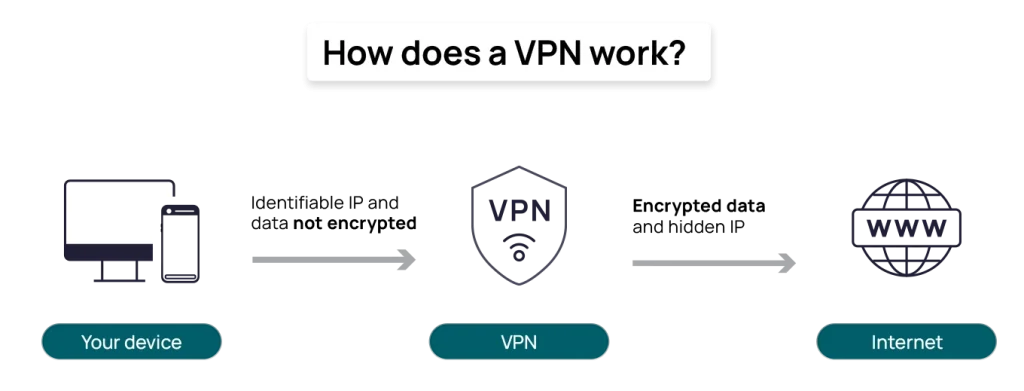
What is a VPN?
Imagine you’re at a coffee shop and need to check your online banking. Without a VPN, your sensitive data travels openly over the public Wi-Fi, making it vulnerable to hackers who might be monitoring the network. With a VPN active, however, your device first establishes an encrypted connection to a remote VPN server. All your traffic is wrapped in strong encryption and routed through a secure tunnel to that server. The VPN server then forwards your request to the bank’s website on your behalf. When the bank responds, the VPN server encrypts the data again before sending it back to you through the same secure tunnel.
This setup keeps your online activity private and protected. Even on an unsecured public Wi-Fi network, anyone snooping can only see meaningless encrypted traffic flowing between your device and the distant VPN server.
In the so-called liberal democracies of the West, the assault on internet privacy is ramping up. After pushing through surveillance laws, age verification mandates, and content restrictions, governments are now targeting VPNs—the very tools people use to sidestep these intrusions. Sold as measures to protect kids or fight piracy, these moves are really about stripping away anonymity and controlling access to information.
VPNs let users mask their location, bypass geo-blocks, and shield their data from prying eyes. That’s precisely why they’re a thorn in the side of policymakers. When citizens fire up a VPN to dodge porn age checks or reach blocked sites, those shiny new regulations start looking pointless. The response? Calls for bans or heavy restrictions.
Take the UK. The Online Safety Act rolled out strict age verification for adult content, triggering a massive spike in VPN adoption—over 6,000% in some cases. Now, under Keir Starmer, amendments to the Children’s Wellbeing and Schools Bill aim to outlaw VPN use for anyone under 16, alongside even tougher age checks for social media. A YouGov poll showed 55% of British adults backing a VPN ban for minors, worried that kids are undermining efforts to block harmful content.
Looks like Australia’s social media ban for under 16s is a colossal failure and the laughing stock of the world. Young people are smart and have easy workarounds for the “ban”. They are openly mocking Anthony Albanese and one even says straight up, “I know who I’m not voting for in a few years”. 😏
— Francynancy (@FranMooMoo) December 18, 2025
Australia’s not far behind. Their new law bars under-16s from platforms like Instagram and TikTok unless they hand over ID. Teens quickly turned to VPNs to get around it, prompting louder demands for crackdowns. U.S. senators like Katie Britt and Josh Hawley have praised the Australian approach as a model, with some states floating their own restrictions.
In the EU, the controversial Chat Control regulation—meant to combat child abuse—evolved into a watered-down version allowing “voluntary” scans of encrypted chats on apps like Signal or WhatsApp. It still bans anonymous accounts and skips proper judicial oversight. Denmark, holding the EU presidency at the time, pushed further with a proposal to ban VPNs for accessing geo-restricted streaming or evading blocks. Privacy advocates slammed it as “totalitarian,” noting it went beyond even Russia’s rules. After public outcry, the minister backpedaled, calling it a wording mishap, but the intent was clear.
The U.S. Cybersecurity and Infrastructure Security Agency (CISA) has warned against personal VPNs, highlighting risks from providers. Meanwhile, many top VPN services have ties to Israel, where tech firms often collaborate closely with intelligence agencies, fueling worries about built-in backdoors.
This isn’t happening in bold strokes—it’s the classic salami tactic. Big overreaches like the original Chat Control or SOPA failed due to massive backlash. So now it’s piecemeal: age verification first, then surveillance expansions, and when VPNs foil the plan, go after the tools themselves.
Politicians overlook how deeply VPNs are embedded in everyday tech. Businesses have relied on them for decades for secure remote access. Blanket bans would cripple corporate networks and the broader internet infrastructure.
At its core, this is about control. Anonymity isn’t just for evading rules—it’s vital for journalists, whistleblowers, and dissidents. When Western governments erode it while lecturing authoritarians abroad, their hypocrisy shows. The Danish retreat proves public pressure works. If it builds elsewhere, we might hold the line before the open internet turns into a fully monitored cage.
List of decent VPNs, depending on your use case.