

Living abroad as an expat gives you a peculiar superpower: the ability to look back at your home country with a blend of longing, confusion, and clinical detachment.
For those of us watching from Berlin, Bangkok, or Buenos Aires, the United States looks like a paradox wrapped in a statistical anomaly. By every hard metric—unemployment, wage growth for the lowest earners, and GDP—America is a colossus. It is outperforming Europe, Japan, and the UK. Yet, every poll, every headline, and every frantic phone call home suggests that the place is emotionally falling apart.
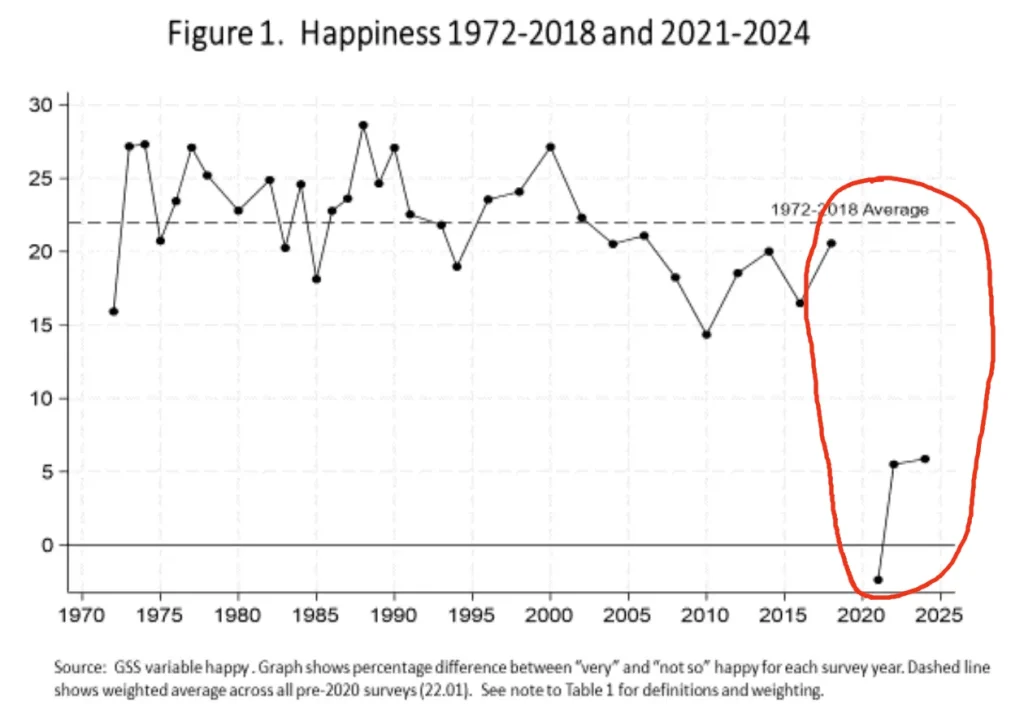
Derek Thompson, writing for his newsletter, recently dissected this conundrum in an essay titled “If America’s So Rich, How’d It Get So Sad?” (referencing a 2026 study by economist Sam Peltzman). The data is startling: The 2020s have not been “Roaring”; they have been the “Tragic Twenties.”
For expats, understanding this emotional collapse isn’t just academic curiosity. It is the key to understanding why you left—or why you might never go back.
The “Vibecession” Is Real
Thompson points out that the Federal Reserve’s measure of worker satisfaction just hit its lowest level since 2014. Consumer sentiment is lower now than it was during the Great Recession or the stagflation of the 1970s.
Economists are baffled. Why? Because the “hard data” (jobs, wages) is great, but the “soft data” (feelings) is in the gutter.
For those of us living abroad, this disconnect is instantly recognizable. When we visit home, we see the expensive trucks in the driveways and the $8 lattes, but we also sense the ambient rage. Thompson identifies the three main suspects for this misery, and they hit close to home for anyone who has escaped the American bubble.
1. The “Permademic” and the Cost of Everything
The pandemic never ended—it just mutated into a financial flu. Thompson notes that between 2020 and 2025, consumer prices surged by the same amount they did in the previous fifteen years.
But here is the twist that expats will understand: The richest Americans are actually the most miserable about this. Why? Because full employment gave low-wage workers bargaining power. Suddenly, the wealthy couldn’t get cheap nannies, cheap DoorDash, or cheap landscaping on demand.
Thompson quotes economist Matt Darling: “Middle- and upper-income households were used to being able to afford low-wage labor on demand… they found this frustrating.”
When you live in a country with a functional social safety net (or simply lower service expectations), you don’t expect serf-level pricing for a cup of coffee. But in the US, the expectation of cheapness broke, and so did the national psyche.
2. The Anglophone Depression
This is the most fascinating part for a global audience. Thompson notes that the World Happiness Report shows that well-being has actually increased in places like China, Vietnam, and even Portugal, Italy, and Spain in the 2020s.
The misery is largely isolated to the Anglosphere: the US, Canada, the UK, Ireland, Australia, and New Zealand.
Why? Thompson posits a few theories: hyper-individualism, diagnostic inflation (labeling normal sadness as a disorder), and a uniquely negative news ecosystem. But one anecdote stands out: In Quebec (where they speak French), youth happiness fell half as much as in the rest of Canada (where they speak English).
It seems there is something about the American/English-language media diet—the constant outrage, the algorithmic doom-scrolling, the culture war—that is uniquely poisonous. As expats, we know this. We turn off the US news for a week and suddenly realize the sky isn’t falling.
3. The Collapse of the Third Place
Finally, Thompson argues that the pandemic broke social trust. Americans no longer trust the government, the media, or even strangers.
The share of Americans who believe other people are “fair” has plummeted. Consequently, we stay home. We isolate. We live our lives mediated by screens.
As expats, we often romanticize the “European piazza” or the “Asian night market”—places where people exist together, in public, without transaction. The US has lost that. When you lose trust in institutions and in the person next to you, you aren’t just sad; you are atomized.
The Expat Verdict
Thompson’s unified theory is this: Inflation + Negativity bias + Solitude = The Tragic Twenties.
For those of us on the outside looking in, the lesson isn’t necessarily “America is doomed.” It is that prosperity without community is poverty.
The US solved the problem of creating wealth, but it failed entirely at distributing peace of mind. When you live abroad, you often trade a higher salary for a slower pace of life. You trade the chaos of the 24/7 news cycle for the quiet ritual of a siesta or a Sunday roast.
America isn’t sad because it is poor. America is sad because it is exhausting. And until the “Permademic” of crisis news and social isolation ends, don’t expect the smiles to return—no matter how high the GDP goes.
Are you happier living outside the US? Have you noticed the “Anglophone sadness” in your travels?