

I’m generally not a fan of Cloudflare—what I often call the cancer of the Internet. But this recent announcement caught my attention:
Cloudflare just made every URL billable.
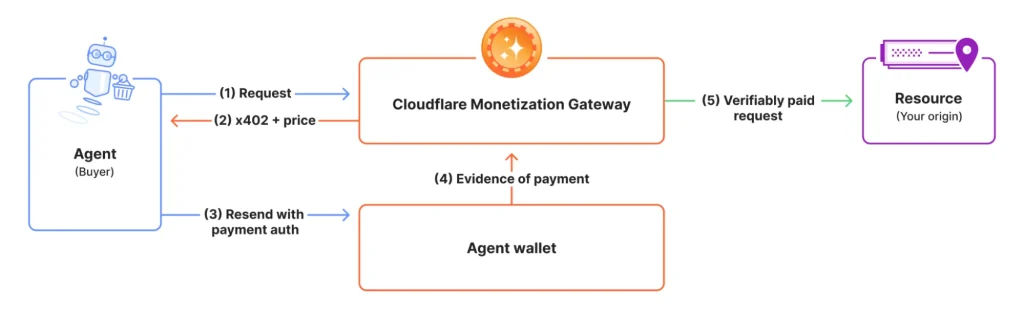
Cloudflare’s new Monetization Gateway allows any resource accessible through its network to be monetized using the x402 protocol. The process is remarkably simple: A client requests a URL and initially receives an HTTP 402 (“Payment Required”) response containing pricing information. The client then pays using a stablecoin (typically USDC on Base) and resubmits the request along with proof of payment.
This immediately reminded me of the original vision for the Internet and Ted Nelson’s Project Xanadu:
Project Xanadu, conceived in the 1960s, was envisioned as a global information network—long before the World Wide Web existed.
Every document would have a permanent, unique address and remain permanently accessible.
Instead of simple hyperlinks, Xanadu proposed bidirectional links, allowing every document to know exactly who was linking to it.
Content could be embedded through transclusion without being copied, so changes to the original would automatically appear everywhere it was referenced.
Authors would automatically receive micropayments whenever their content was accessed—essentially built-in payment links.
The system would have combined features of the Web, Wikipedia, Git version control, citation databases, and an integrated payment system.Why wasn’t it implemented?
The concept was technically far more ambitious and became increasingly complex. The World Wide Web, developed by Tim Berners-Lee in 1989–1990, was dramatically simpler: one-way links, no built-in version control, and no payment system. That simplicity is precisely what made it so successful.
Many of Xanadu’s ideas—versioning, permanent references, embedded content, and micropayments—have since reappeared in various systems, but never as one unified platform.
Investment Thesis: Why This Matters
1. AI companies scrape website content for free to train their models.
2. Newspapers have never solved the micropayment problem. Who wants to buy an annual subscription just to read a single article?
HTTP 402 (“Payment Required”) could offer a solution to both problems. Cloudflare already provides AI bot detection and blocking. Publishers could simply require payment before AI bots gain access to their content. For the first time, there would be a practical way to monetize individual newspaper articles as well as charge AI bots for accessing online content.
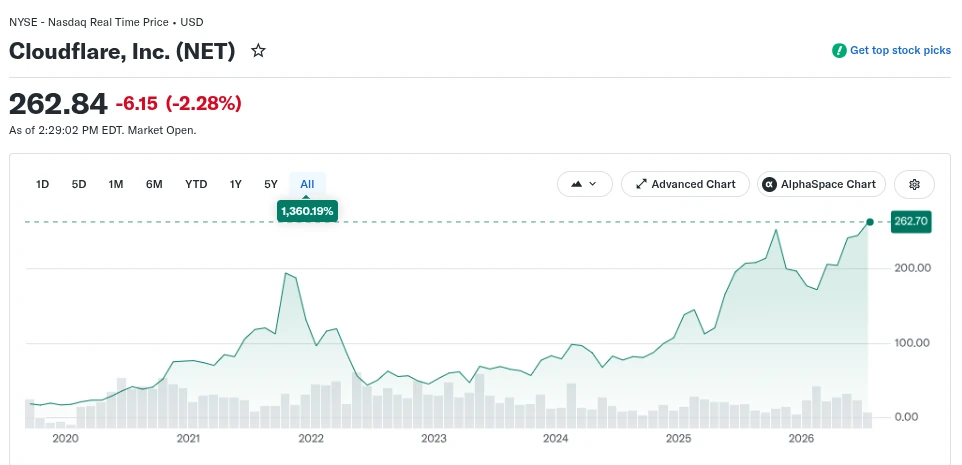
Cloudflare commands a hefty valuation, with a market capitalization approaching $100 billion. For comparison, Volkswagen’s market cap is roughly $50 billion. I’m not making a case for or against investing in the company, but I do find the underlying idea fascinating. If this model gains widespread adoption, Cloudflare could end up taking a small cut from transactions across a significant portion of the Internet.